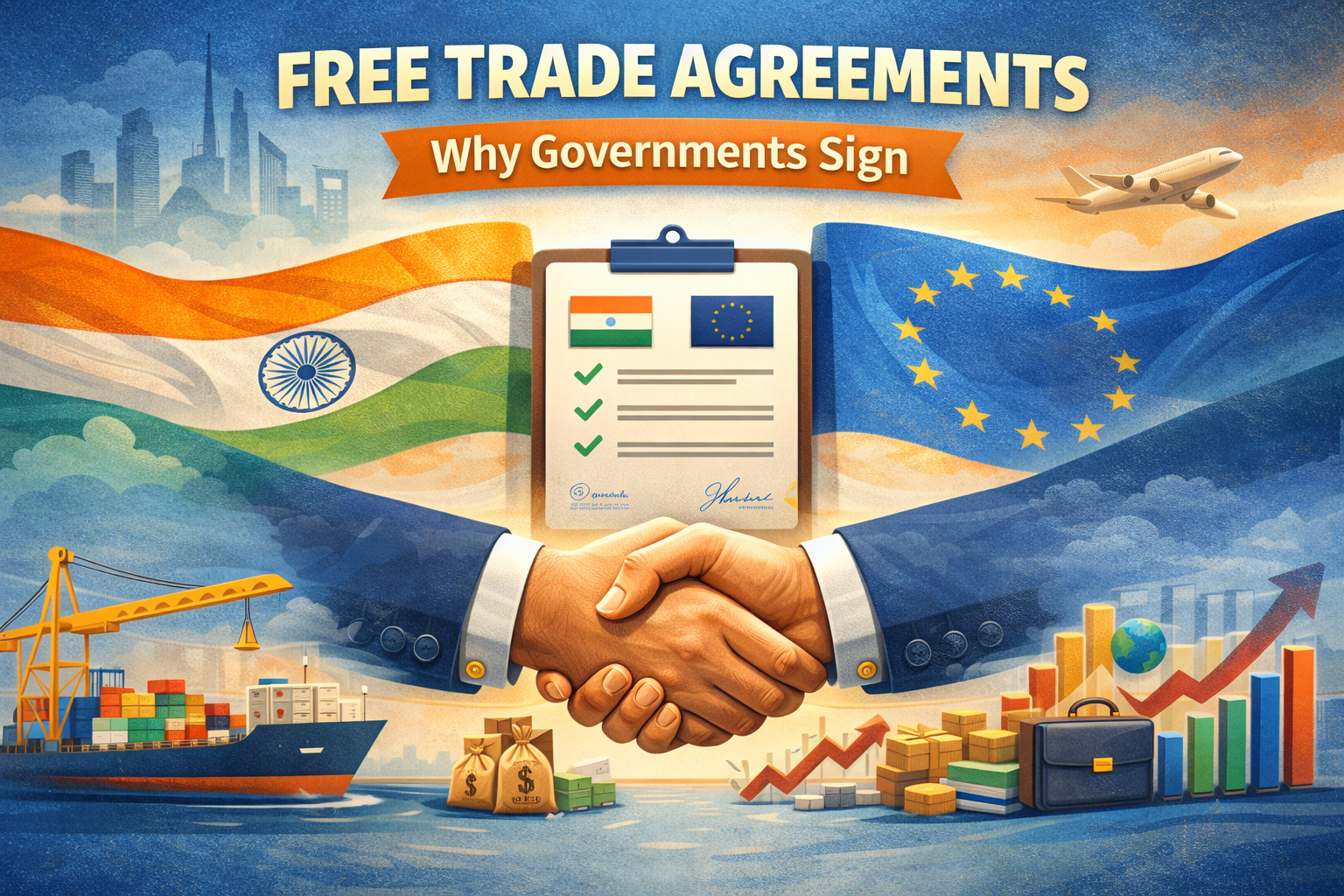
When countries announce new Free Trade Agreements (FTAs), the news often sounds technical and distant from everyday life. Terms like tariffs, market access, and trade negotiations can feel abstract. However, governments sign FTAs because these agreements play a direct role in shaping economic growth, employment, prices, and a country’s position in the global economy.
To understand modern economic policy, it is important to know why governments invest years negotiating free trade agreements and what they hope to achieve through them.
What Is a Free Trade Agreement?
A Free Trade Agreement (FTA) is a formal agreement between two or more countries to reduce or remove barriers to trade. These barriers usually include customs duties (tariffs), import quotas, and restrictive regulations.
The basic idea behind an FTA is simple:
when trade becomes easier and cheaper, businesses can sell goods and services across borders more efficiently, benefiting both producers and consumers.
FTAs do not eliminate all trade rules. Instead, they create a structured and predictable framework that governs how countries trade with each other.
The Main Reasons Governments Sign FTAs
Governments sign free trade agreements for several interconnected reasons.
1. To Increase Exports
One of the primary goals of an FTA is to boost exports. When tariffs are reduced, domestic products become cheaper and more competitive in foreign markets.
For exporting businesses, this opens access to larger consumer bases. For governments, higher exports support economic growth, industrial expansion, and foreign exchange earnings.
2. To Attract Investment
Countries with strong trade agreements are more attractive to foreign investors. Predictable trade rules reduce uncertainty, making it easier for companies to plan long-term investments.
Many governments sign FTAs to signal that their economy is open, stable, and integrated with global markets. This can lead to increased foreign direct investment, technology transfer, and job creation.
3. To Create Jobs and Support Industry
FTAs can support employment by expanding industries that rely on exports. Manufacturing, logistics, services, and agriculture often benefit when access to international markets improves.
At the same time, governments usually negotiate gradual tariff reductions and safeguards to protect sensitive domestic sectors from sudden competition.
4. To Strengthen Strategic Relationships
Trade agreements are not only economic tools; they are also strategic instruments. FTAs help countries deepen relationships with key partners, diversify trade away from overdependence on a single region, and strengthen geopolitical ties.
In a changing global environment, FTAs help governments secure supply chains and reduce vulnerability to external shocks.
Are There Risks in Free Trade Agreements?
While FTAs offer many benefits, they are not without risks.
Increased competition can challenge domestic industries that are less efficient or technologically advanced. Small producers may struggle to compete with large international firms.
This is why governments negotiate FTAs carefully. They often include:
- phased tariff reductions
- sector-specific protections
- rules of origin to prevent misuse
A successful FTA balances openness with domestic economic priorities.
Why FTAs Matter in India’s Context
For a country like India, free trade agreements are part of a long-term development strategy.
India signs FTAs to:
- expand market access for Indian exporters
- integrate into global value chains
- support manufacturing and services growth
- reduce trade barriers in key markets
FTAs also help India manage trade deficits by encouraging export growth and diversifying trading partners.
How FTAs Affect Citizens
Although FTAs are negotiated by governments, their effects reach ordinary citizens over time.
They can influence:
- availability and prices of imported goods
- job opportunities in export-oriented industries
- business expansion and investment
- overall economic stability
Understanding FTAs helps citizens better interpret economic news and government policy decisions.
Final Takeaway
Governments sign free trade agreements not for short-term political gains, but to shape long-term economic outcomes. When designed and implemented carefully, FTAs can support growth, jobs, investment, and global integration.
However, their success depends on domestic preparedness, complementary policies, and ongoing evaluation. FTAs are tools—not guarantees—but they remain central to how modern economies engage with the world.
Leave a Reply