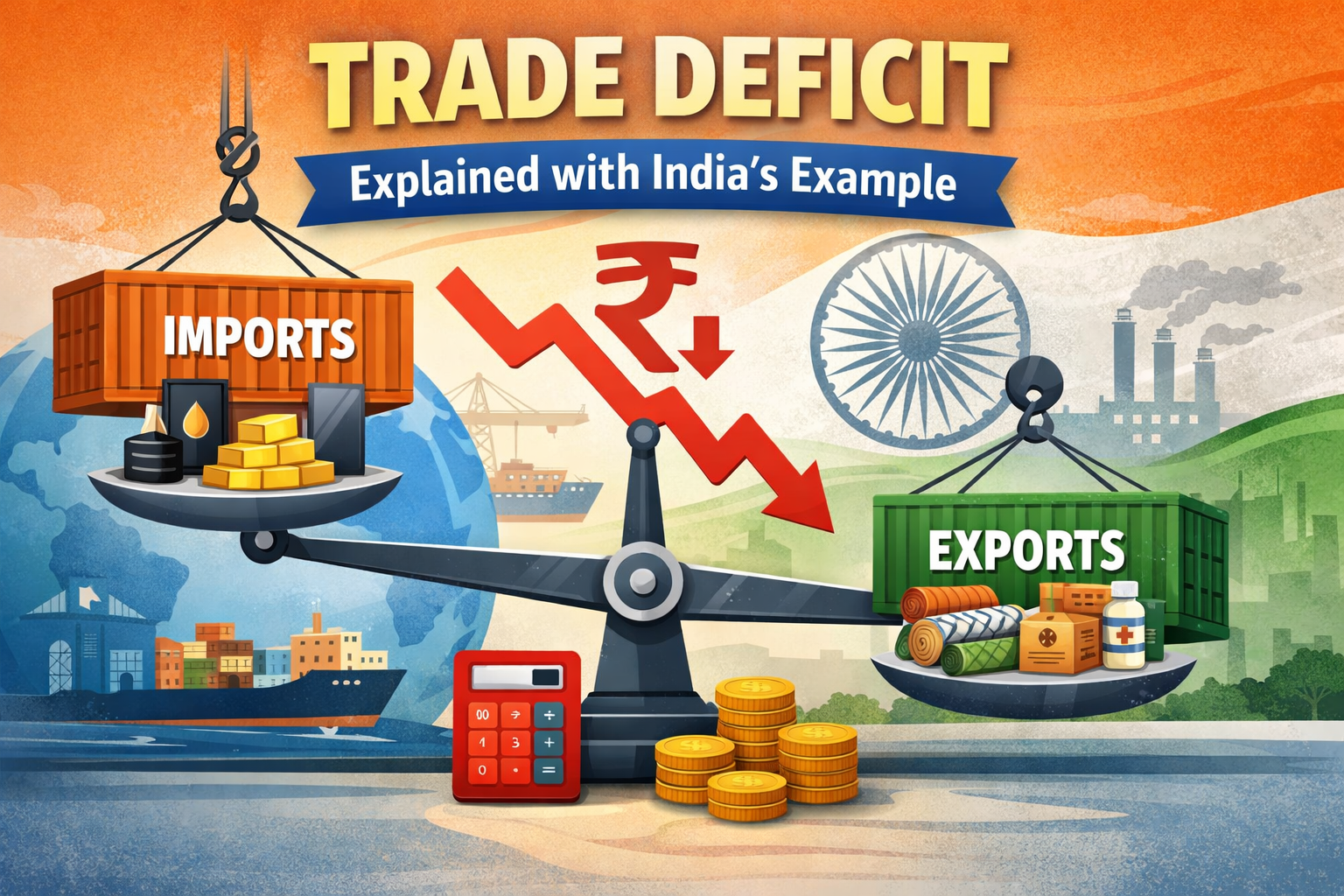
Economic terms often appear in news headlines, budget discussions, and policy debates, but they are rarely explained in a way that feels relatable. One such term is trade deficit. While it may sound technical, a trade deficit has real consequences for a country’s economy and, indirectly, for the daily lives of its citizens.
To understand issues like currency movement, import prices, government policy decisions, and trade agreements, it is important to first understand what a trade deficit is and how it applies to India.
What Is a Trade Deficit?
A trade deficit occurs when a country imports more goods and services than it exports over a certain period, usually a month or a year.
In simple terms:
- When a country buys more from the rest of the world than it sells, it runs a trade deficit.
- When it sells more than it buys, it enjoys a trade surplus.
Trade deficit data is closely monitored by governments, economists, and investors because it reflects how a country is interacting with the global economy.
India’s Trade Deficit Explained Simply
India is a fast-growing economy with a large population and expanding consumption needs. To support growth and daily demand, India imports several essential items, including crude oil, gold, electronics, machinery, fertilizers, and industrial raw materials.
At the same time, India exports products such as pharmaceuticals, textiles, engineering goods, chemicals, agricultural products, and software services.
However, the value of India’s imports—especially crude oil and electronics—often exceeds the value of its exports. As a result, India frequently runs a trade deficit.
This deficit is not new. It has been a consistent feature of India’s economy for decades, largely due to structural dependence on energy imports and rising domestic consumption.
Why Does India Import More Than It Exports?
There are several reasons why India experiences a trade deficit.
First, India does not produce enough crude oil domestically to meet its energy needs. Since oil is essential for transport, industry, and power generation, large imports are unavoidable.
Second, India imports high-value electronics, machinery, and technology that support manufacturing, infrastructure, and consumer demand.
Third, while India’s service exports—such as IT and software—are strong, they do not always fully offset the high cost of physical imports.
Together, these factors keep India’s import bill higher than its export earnings.
Is a Trade Deficit Always a Bad Thing?
A trade deficit is not automatically harmful. In many cases, it can be a sign of economic growth.
A trade deficit is manageable when:
- imports support infrastructure, manufacturing, or productivity
- the economy is expanding
- foreign investment flows remain strong
- exports are growing steadily over time
However, a trade deficit becomes a concern when:
- it widens rapidly
- exports fail to keep pace
- foreign capital inflows decline
- the country relies heavily on borrowing
The key issue is not the existence of a trade deficit, but whether it is sustainable.
How a Trade Deficit Affects the Indian Economy
A persistent trade deficit can have several economic effects.
It can put pressure on the national currency, making imports more expensive. This often leads to higher prices for fuel, transportation, and imported goods.
A higher import bill can also increase inflation, especially in a country like India where fuel costs influence the prices of many everyday items.
In addition, a large trade deficit increases the need for foreign capital—through investment or borrowing—to finance imports. If such capital becomes scarce, it can create economic stress.
This is why trade policy, export promotion, and manufacturing growth remain key government priorities.
How Trade Deficits Shape Government Policy
Governments use multiple tools to manage trade deficits.
These include promoting exports, encouraging domestic manufacturing, reducing unnecessary imports, and signing trade agreements to access new markets.
Initiatives such as improving ease of doing business, supporting exporters, and negotiating trade agreements are often aimed at narrowing the trade deficit over time, not eliminating it entirely.
In India’s case, the goal is to balance growth with external stability while ensuring that imports continue to support development needs.
Why Trade Deficit Matters to Citizens
While trade deficits may seem like an abstract concept, their impact eventually reaches households.
They can influence fuel prices, imported product costs, inflation trends, and government spending decisions. Over time, they also shape job creation and investment patterns.
Understanding trade deficits helps citizens better interpret economic news and understand why governments take certain policy decisions related to trade, industry, and foreign relations.
Final Takeaway
A trade deficit simply means that a country is importing more than it exports. For India, this has been a long-standing reality driven by energy needs, consumption growth, and development priorities.
A trade deficit is not a crisis by default, but it requires careful management. The focus lies in strengthening exports, improving domestic production, and ensuring that trade imbalances remain sustainable in the long run.
By understanding what a trade deficit is and how it affects India, citizens can better connect global economic trends with everyday economic realities.
Leave a Reply