India rarely dominates the global news cycle.
When it does, it is often during moments of disruption — an election, a border incident, or a high-profile diplomatic summit. In the long stretches between headlines, however, India continues to shape global politics in ways that are quieter, slower, and more structural than dramatic.
For much of the world, India is still understood primarily as a regional power with global ambitions. Increasingly, it functions as something else: a country whose internal choices intersect with global outcomes, whether or not it seeks attention for them.
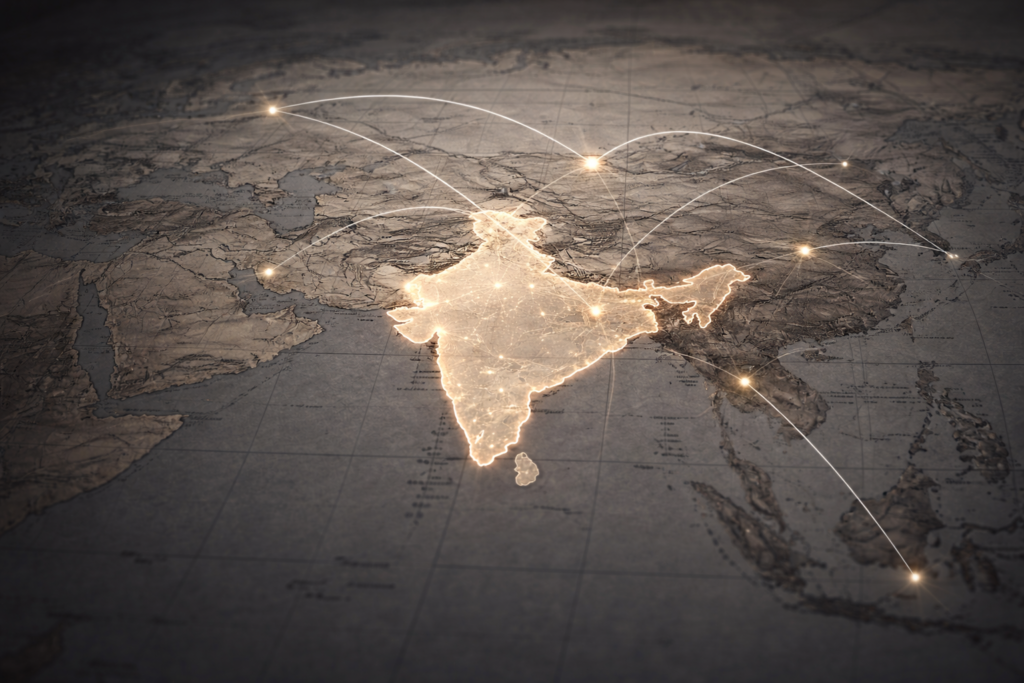
Influence Rooted in Scale, Not Posturing
One reason India’s role in global politics is often underestimated is that it is rooted less in projection than in scale.
With the world’s largest population and a steadily expanding economy, India influences global demand, labour markets, energy consumption, and supply chains simply by weight. Decisions taken domestically — on manufacturing policy, digital regulation, or climate commitments — rarely remain confined within national borders.
In a global system shaped increasingly by demographics and consumption rather than ideology alone, India’s relevance is structural. It does not need to announce itself loudly to be noticed.
Geography Without Confrontation
India’s geographic position places it at the intersection of several regions central to global stability.
It sits astride major maritime trade routes, anchors South Asia — one of the most densely populated regions in the world — and occupies a pivotal position in the Indo-Pacific, an area that has become increasingly significant as power balances shift. Unlike countries that use geography as leverage through confrontation, India has largely treated its location as something to manage rather than exploit.
The result is a form of influence that is indirect but persistent. Stability within India affects shipping lanes, regional security, and diplomatic calculations far beyond its immediate neighbourhood.
A Foreign Policy That Resists Easy Alignment
India’s approach to foreign policy has long resisted simple categorisation.
Rather than anchoring itself firmly within a single alliance system, India has pursued what it describes as strategic autonomy — maintaining working relationships across competing blocs while preserving space for independent decision-making. This posture has occasionally frustrated partners seeking predictability, but it has also allowed India to navigate a shifting global order with flexibility.
In a world increasingly shaped by rigid alignments, India’s reluctance to commit fully to any one camp has made it an actor that others must continually reassess.
Democracy at an Unusual Scale
India’s political system adds another layer to its global relevance.
As one of the largest democracies in the world, India operates at a scale few political systems attempt. Governing a population of this size, with deep linguistic, religious, and economic diversity, has made India a reference point — sometimes aspirational, sometimes cautionary — for countries grappling with similar pressures.
For global observers, India is less a model than a case study: an example of how democratic governance functions under conditions of scale, constraint, and complexity.
Domestic Choices With Global Consequences
As India’s economy integrates further into global systems, the boundary between domestic policy and international impact has grown increasingly thin.
Decisions on industrial policy, data governance, and environmental regulation now shape negotiations with multinational corporations and foreign governments alike. As supply chains are re-evaluated and economic dependencies reconsidered, India’s internal priorities have begun to matter to actors far beyond its borders.
This has elevated India’s global relevance without requiring overt geopolitical ambition.
Influence That Rarely Looks Like Power
India’s role in global politics is often missed because it does not resemble traditional expressions of power.
It does not dominate headlines through military intervention or diplomatic ultimatums. Instead, its influence accumulates through continuity — sustained growth, institutional persistence, and strategic restraint. This makes India less visible during moments of crisis, but more consequential over time.
Global politics is shaped not only by those who speak the loudest, but also by those whose presence must be accounted for, even when they remain largely silent.
Looking Beyond the Headlines
For policymakers, businesses, and researchers, understanding India increasingly requires a shift in perspective.
Its significance lies not in sudden moves or dramatic gestures, but in the steady expansion of its relevance across economic, political, and institutional domains. Ignoring India does not reduce its impact; it merely obscures it.
As global power becomes more diffused and less predictable, countries that combine scale, continuity, and strategic patience acquire a different kind of importance. India is steadily becoming one of them.
Leave a Reply