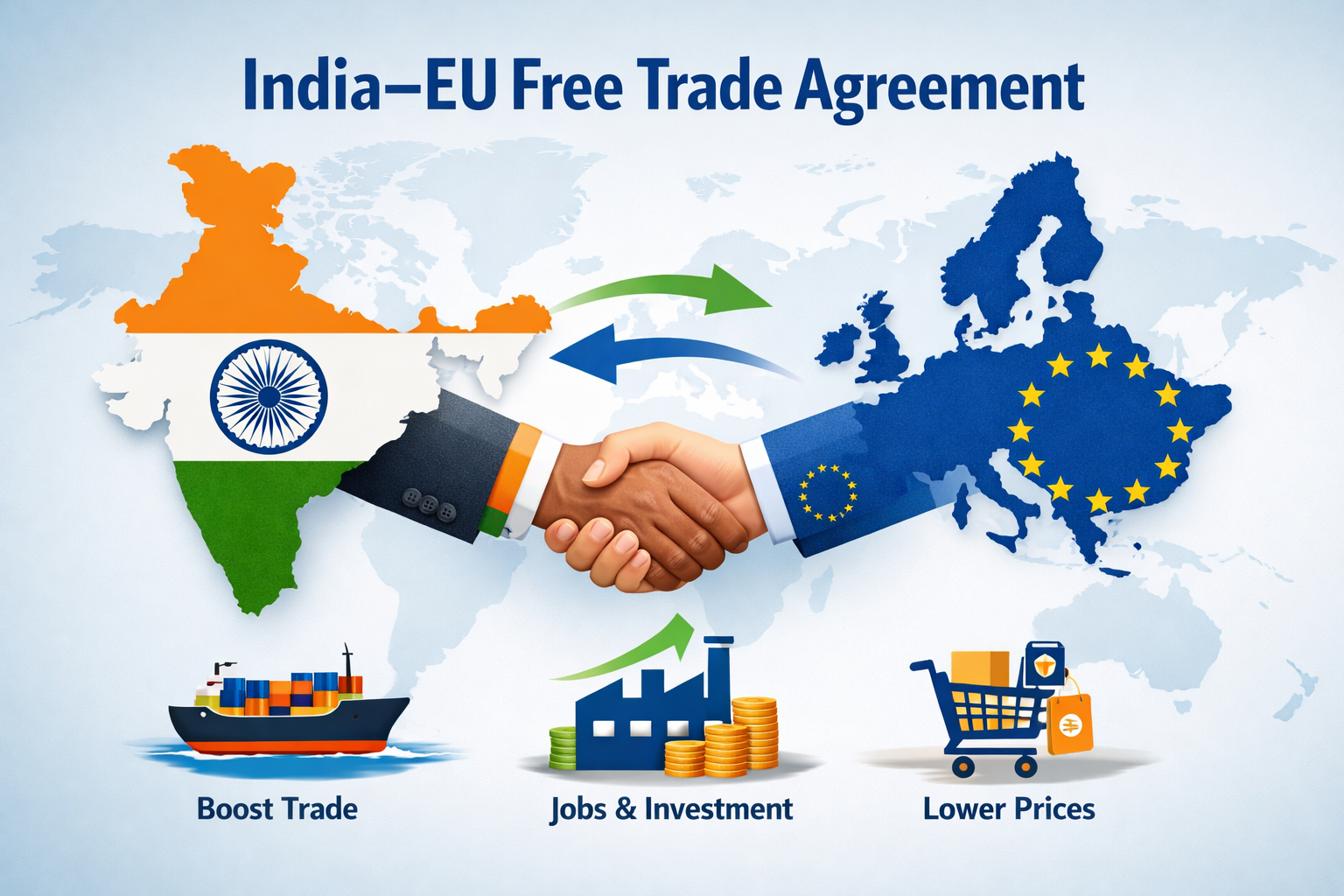
India recently reached a significant milestone in its global trade strategy by signing a Free Trade Agreement (FTA) with the European Union (EU) — one of the largest economic blocs in the world. The deal, signed at a summit in New Delhi in late January 2026, comes at a time of global economic uncertainty and growing interest in diversified trade relations.
This agreement is being described by leaders on both sides as a historic pact that could reshape trade, investment, and economic cooperation between India and Europe. But what exactly does this trade deal entail, and why should everyday Indian citizens care about it?
The India EU Free Trade Agreement is a landmark trade deal between India and the European Union that aims to reshape trade, jobs, and investment.
What Is the India–EU Free Trade Agreement?
A Free Trade Agreement (FTA) is a pact between two or more trading partners to reduce or eliminate tariffs (taxes on imports and exports) and other trade barriers on goods and services. The goal is to make trade easier, cheaper, and more predictable.
Under the India–EU FTA:
- A large percentage of Indian goods exported to the EU will enjoy preferential or zero tariffs.
- EU exports to India will face reduced duties in many sectors.
- Both sides will work on regulatory cooperation and greater market access over time.
The deal is expected to deliver unprecedented market access for Indian exporters, covering nearly 99% of Indian exports by trade value under preferential terms.
Why This Deal Is Being Called “Historic”
Indian and European leaders have used strong language to describe this pact. New Delhi and Brussels have said the agreement could be a “game-changer” for their economic relationship, merging two major economic blocs into an integrated trade framework.
This is not just another trade deal — it reflects nearly two decades of negotiation, cooperation, and diplomacy. Trade agreements of this scale are rare and take years of patience and compromise to finalise.
How the India–EU FTA Affects Indian Jobs and Businesses
For India, the potential gains from this FTA are large and multi-layered:
1) Boost to Exports
Many Indian products such as textiles, leather goods, engineering items, and chemicals will become more competitive in European markets due to lower tariffs. This could unlock significant export potential worth billions of dollars annually.
2) Market Opportunities
EU markets are among the richest and most diverse in the world. With reduced trade barriers, Indian MSMEs (micro, small, and medium enterprises) and exporters can reach millions of new customers across 27 European countries.
3) Jobs and Investment
Greater exports and market access can lead to expanded production capacity in India, creating new employment opportunities — particularly in labour-intensive sectors like textiles and manufacturing. European companies may also increase investment in India’s economy.
What It Means for Consumers
FTAs do not benefit only producers. They can lead to lower prices and better product choices for consumers:
- Imported goods from the EU such as machinery, pharma products, and technology could become cheaper over time due to reduced tariffs.
- Increased competition may encourage Indian companies to innovate and improve product quality.
However, price changes may not happen immediately and depend on how businesses pass savings to consumers.
Strategic Importance Amid Global Uncertainty
This agreement has been signed at a moment when global trade is facing pressure from geopolitical tensions, rising protectionism, and shifting economic alliances. The India–EU FTA signals that India is actively positioning itself to be an important player in global markets, with diversified trade relationships beyond any single partner.
By deepening ties with the EU — and by continuing trade discussions with other partners — India is attempting to:
- enhance economic stability
- strengthen supply chain resilience
- expand global market integration
This broader strategy matters for long-term economic growth, jobs, and investment.
How This Is Different From Other Trade Talks
Sometimes trade news can be confusing. For example, while India has ongoing trade dialogues with countries like the United States, those talks do not constitute an FTA at this point. The India–EU FTA, in contrast, is a formal and structured trade agreement that has now been signed and is moving toward implementation.
Final Takeaway
The India–EU Free Trade Agreement is much more than a diplomatic headline. It represents:
- deeper economic integration
- new export opportunities
- potential for job creation
- access to a large, wealthy consumer market
For Indian citizens, this means that trade policies are not abstract concepts — they influence economic growth, business opportunities, product prices, and India’s global role.
Understanding these developments helps citizens connect international economics to everyday life and see how global trade decisions can shape the country’s future.
Leave a Reply