President Donald Trump and Prime Minister Narendra Modi once embodied the kind of leader-to-leader chemistry that reshapes alliances. From massive diaspora rallies to mutual praise during crises, their “bromance” propelled US-India ties to new heights between 2017 and 2020. Yet by early 2026, that warmth had curdled into tariffs, public sniping, and a trade war that’s left both nations scrambling for footing. What began as a personal triumph for strategic partnership devolved into a cautionary tale of ego, economics, and geopolitics clashing head-on.
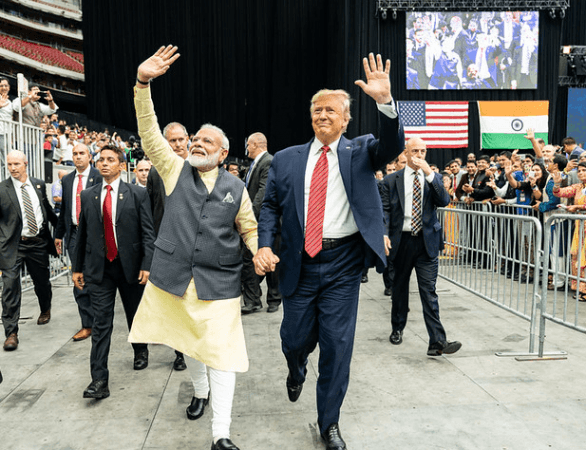
Their story kicked off in May 2017, when Modi landed in Washington for a state visit heavy on symbolism. Trump, ever the showman, rolled out the red carpet, securing $3 billion in defense deals while glossing over thorny issues like H-1B visas that irked India’s tech sector. The rapport built quickly. By September 2019, 50,000 Indian-Americans packed Houston’s NRG Stadium for “Howdy Modi,” where Trump joined Modi onstage, riffing on trade and China. Months later, Trump reciprocated with “Namaste Trump” in Ahmedabad—110,000 spectators, fighter jet flyovers, and Bollywood beats creating an event more spectacle than summit.
Even COVID-19 couldn’t dim the glow. Trump shipped hydroxychloroquine to India amid global shortages, and Modi sent traditional medicine stateside. When Chinese troops killed 20 Indian soldiers in the June 2020 Galwan Valley clash, Trump offered mediation—politely rebuffed by Delhi, but their public support underscored a budding “natural partnership” via the Quad alliance. Trade boomed to $190 billion annually, though Trump’s steel tariffs and GSP revocation tested Modi’s patience. Still, deals like COMCASA deepened military interoperability, positioning India as a counterweight to Beijing.
Fast-forward to November 2024: Trump’s reelection victory drew one of Modi’s speediest congratulations, hailing it as “historic.” Trump fired back, calling Modi a “true friend” who’d stared down “death threats”—a veiled nod to Pakistan. Pundits buzzed about “Trump-Modi 2.0,” anticipating tech transfers under iCET and Indian factories offsetting China risks. Modi’s team even sent Vice President Jagdeep Dhankhar to the January 2025 inauguration, signaling priority.
But “America First 2.0” crashed the party. Trump’s obsession with the $46 billion US-India trade deficit dominated early talks. Modi’s February 2025 Washington trip netted $4 billion in LNG pledges to soothe tariff fears, yet Trump dismissed it as coming back “empty-handed.” Immigration soured further: US deportations hit 1,200 Indians by May, mostly H-1B overstays, sparking Delhi outrage.
The real fracture came in May 2025 with a terror attack in Kashmir’s Pahalgam, killing 12 tourists and pinned on Pakistan’s Lashkar. Trump pledged “full support,” then stunned India by claiming he’d brokered a “dramatic ceasefire” using trade incentives for Islamabad. Foreign Secretary Vikram Misri shot back: no US mediation occurred. Modi reiterated this in a June call, but Trump leaned in, touting Nobel-worthy peace efforts that clashed with India’s non-alignment doctrine.
Summer brought the hammer. August tariffs—25% on $50 billion of Indian textiles and pharma, ballooning to 50% over Russia’s oil (India’s imports doubled to 1.7 million barrels daily)—ignited retaliation. “India’s ripping us off,” Trump tweeted, ignoring Quad contributions. Modi fired back mildly with walnut duties but accelerated EU FTAs and a China border thaw. A Trump-Modi Quad summit in India? Scrapped. Trump’s Pakistan arms resumption echoed 1990s grievances.
Public barbs escalated. At a Kolkata rally, Modi quipped, “Friends don’t tariff friends.” Trump Truth Socialed: “Modi loves me, but India’s dumping steel.” Their September phone call was tense, fruitless; Modi skipped the UNGA. Flashpoints piled up: Trump’s Nobel push flopped amid Indian lobbying; GE jet engines and drones stalled; CAATSA blocked S-400 waivers. Trade volumes dropped 15%, Indian FDI to the US halved, BJP hardliners cried betrayal, and US Democrats pounced.
By December 2025, the chill deepened, but February 2026 brought a pragmatic flicker. A joint statement post-call recommitted to Quad revival, energy ties, and “trusted partnership.” Tariffs linger, yet mutual needs—India’s tech hunger, Trump’s China pivot—hint at thaw. Analysts at Lowy warn of “unraveled” relations creating a China vacuum; CFR sees enduring $200 billion trade and 4 million diaspora as glue.
This saga spotlights leader-centric diplomacy’s double edge. First-term flattery masked frictions; second-term egos exploded them. India diversified to Europe and the Gulf; America forfeited leverage. Lessons abound: institutionalize beyond personalities, balance tariffs with reciprocity, reform H-1B. Fundamentally, democracies versus autocracies align them still—but without reset, hugs yield to headaches.
Trump vs Modi Timeline Highlights
| Year | Key Event | Outcome |
|---|---|---|
| 2017 | White House Meet | $3B defense boost |
| 2019-20 | Howdy/Namaste Rallies | Bromance peaks |
| 2024 | Trump Win | Reunion optimism |
| Feb 2025 | Modi Visit | LNG deals, deficit drama |
| May 2025 | Kashmir Claim | Mediation meltdown |
| Aug 2025 | Tariffs Hit | Trade war ignites |
| Feb 2026 | Joint Statement | Cautious reset |
In the end, Trump vs. Modi proves personal vibes can’t conquer cold economics forever. Yet their convergence endures—watch tariff talks and Quad moves for the next chapter.
Leave a Reply