A Country Defined by Its Age
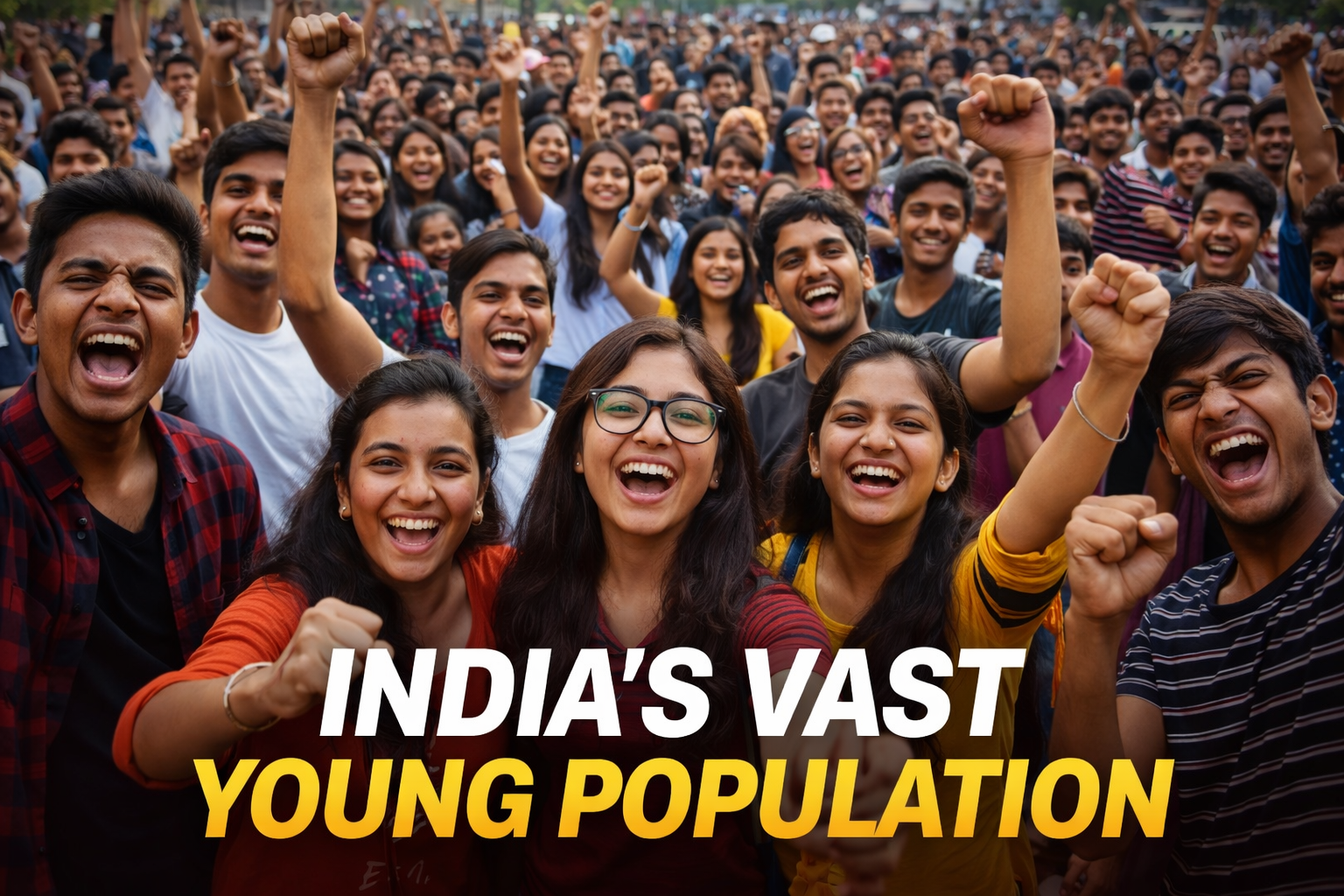
India is often described as a young nation, a phrase repeated so frequently that it has almost lost its meaning. Yet behind this description lies a rare and time-bound economic reality.
More than half of India’s population is of working age. Every year, millions of young people step out of classrooms and into the labour market, carrying with them expectations of stability, dignity, and upward mobility. Economists refer to this phase as a demographic dividend — a period when a country has a higher proportion of productive workers than dependents.
History shows that such moments can accelerate growth, strengthen institutions, and lift large populations into the middle class. But history also shows something else: demographic advantages do not convert themselves into prosperity. They require deliberate economic choices.
What the Demographic Dividend Really Means
At its core, the demographic dividend is not about population size. It is about population structure.
When a country has more people working than depending on others for support, it gains room to:
- Increase productivity
- Expand domestic consumption
- Collect higher tax revenues
- Invest more in infrastructure and public services
For India, this window is expected to remain open for the next decade or two. After that, the population will begin to age, and the economic equation will change.
This makes the present moment unusually important. India is not simply growing; it is growing within a deadline.
Why a Young Population Can Strengthen the Economy
A youthful workforce has tangible economic effects that go beyond employment statistics.
Young workers tend to be more mobile, more adaptable, and more open to new technologies. This has supported India’s rapid digital adoption, from online payments to platform-based services. It has also helped fuel entrepreneurship, particularly in urban centres where young founders and workers have reshaped sectors like education, finance, and logistics.
At a household level, younger populations spend differently. Consumption increases in areas such as housing, transportation, education, healthcare, and discretionary services. This demand sustains growth even when external economic conditions weaken.
In theory, India’s youth population should provide both the labour and the demand needed for long-term economic expansion.
The Pressure Beneath the Promise
Yet optimism alone cannot hide the strain within the system.
Each year, India’s economy must absorb millions of new workers. While jobs are being created, the pace and quality of employment often lag behind the scale of demand. Many young Indians find work, but not the kind that offers stability, security, or income growth.
This results in a quieter problem than unemployment: underemployment. Degrees do not always translate into skills that industries need. Informal work remains widespread. Career paths are uncertain, particularly outside major cities.
When expectations rise faster than opportunities, the demographic advantage begins to feel fragile.
Education, Skills, and the Mismatch Problem
One of the most critical challenges in India’s youth economy is the gap between education and employability.
The number of graduates has increased significantly over the past two decades. However, economic change has been faster than curriculum reform. Industries now require skills that are practical, adaptable, and continuously updated, while many education systems still reward memorisation and credentials.
As technology reshapes work, skills lose relevance more quickly than before. This places pressure not only on young workers but also on institutions responsible for preparing them.
A young population without the right skills is not an asset. It is unrealised potential.
The Cost of Missing the Moment
Demographic windows do not remain open indefinitely. As populations age, economies face new pressures — rising healthcare costs, pension obligations, and slower workforce growth.
If India fails to convert its youth population into productive employment during this period, the opportunity cannot simply be postponed. The economic consequences would unfold gradually: slower growth, fiscal strain, and increased social tension.
This is why the youth question is not just about employment figures. It is about timing, preparedness, and policy coherence.
Why This Affects Everyday Life
For individuals, the structure of the population shapes daily realities:
- Job competition and wage growth
- Migration from smaller towns to cities
- Household financial stability
- Long-term career security
For society, it influences trust in institutions, political participation, and social cohesion. When large numbers of young people feel excluded from economic progress, the effects extend well beyond economics.
A Narrow Window, Not a Guaranteed Future
India’s young population is neither a guarantee of success nor a looming crisis by default. It is a condition — one that demands careful management rather than celebration.
Handled well, it can support decades of growth and resilience. Handled poorly, it will be remembered as a moment when potential exceeded preparation.
The real question is not whether India is young, but whether it is ready.
Leave a Reply